
Hoboken and the surrounding Hudson County area
Mold Inspection and Testing in Hoboken, NJ
Find out what the mold actually is, how far it runs and what water is feeding it, in a written report from a company with nothing to gain from the answer.
Mold Testing quote
Describe what you can see, what the room smells like, whether anything is still wet, and whether you own the unit or rent it. People are surprised how much that last answer changes. Those four together normally tell us whether an assessment is the step you are actually on.
Would you rather talk it through? Call (315) 640-3590, answered 24/7.
$100 off your first job
Credited by us on your first booked job.
- One credit per customer per property, on your first booked job.
- Valid through December 31, 2026.
Mention this offer when you book. Full terms.
What an independent assessment puts in your hands
What you get is a document you can put in front of somebody else. It names the rooms, the measured area, the wet material, the water feeding it and what putting it right involves, with moisture readings and dated photographs behind it. Removal contractors bid against that document, a landlord or a condo board has to answer it, and an insurer or a housing inspector will ask to see it. The reason to buy it on its own is the part nobody in this market says out loud: New Jersey issues no mold assessor license and no mold remediator license, so no state agency has vetted whoever walks into your basement, and nothing stops the company that finds the problem from selling you the cure. The Department of Health takes the same view, and its own list of indoor environmental remediation firms carries a standing warning that, due to a potential conflict of interest, the company conducting your assessment should not be the company conducting the remediation. We arrange the assessment as its own engagement and keep the removal in different hands.
- A room by room walkthrough of the affected space, the basement or garden level and any shared wall, with the growth, the staining and the musty smell recorded where they are found
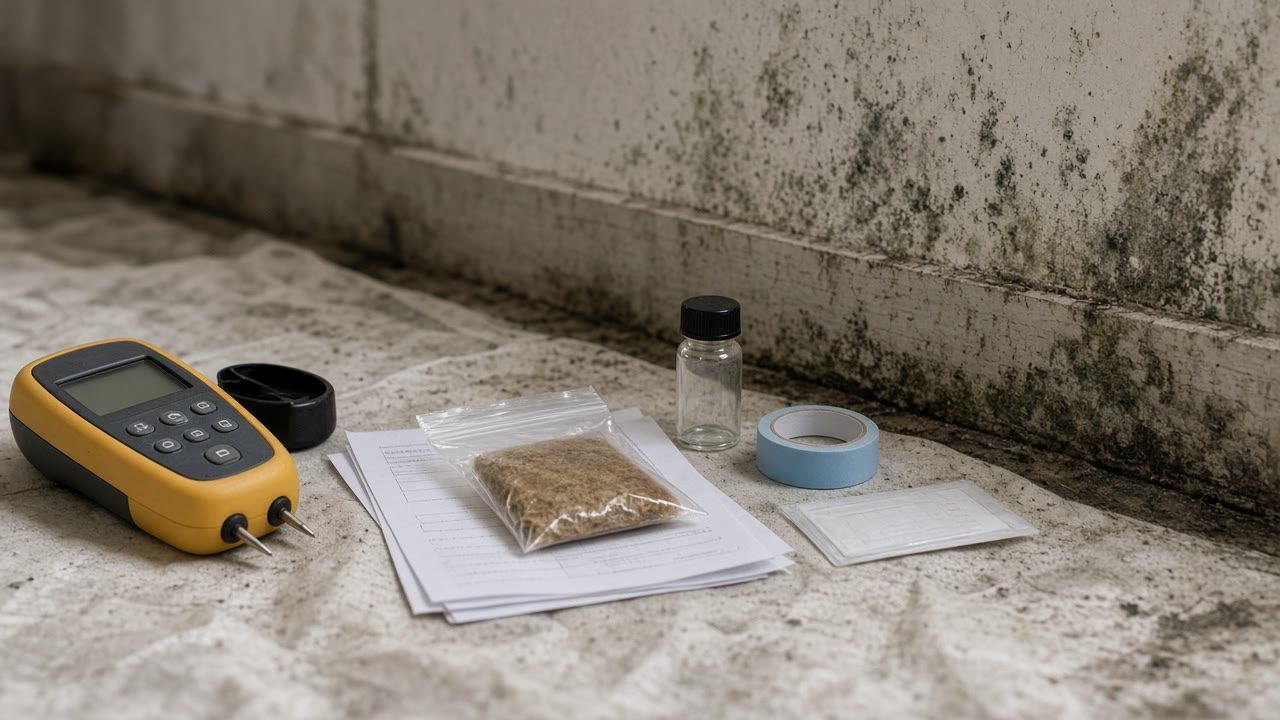
- Meter and thermal imaging sweeps to locate wet material behind plaster, under tile beds and inside stud cavities
- Tracing the water to a source: a parapet or roof, a riser, a failed seal, a floor drain that backed up, or summer condensation on a cold surface
- Measuring the affected area, because the size of it is what decides whether this is a weekend or a contract
- Air or surface sampling only where the result would change a decision, never as a matter of routine
- A written scope: areas and quantities, the method per area, the containment required, and the test that says the work is finished
- Documentation assembled for a landlord, a management company, a condo board, an insurance claim or a housing inspector
- Post-remediation verification: readings, photographs and a written record after the work, by someone who had no part in the removal
What decides how far an assessment has to go in a Hoboken building
Two apartments with the same dark patch can need very different visits. What moves it is the building, where the water came from, and who else has to read the result.
Whether you own the wall
About 66 percent of occupied homes in Hoboken are rentals, so the person who finds the mold is usually not the person who will pay to open the wall. When a landlord, a management company or a board has to be persuaded, the assessment has to be written to be read by them, and that changes what gets measured, dated and photographed.
How many units are in the building
Three units is the line that decides who enforces. Buildings with three or more rental units register with the state Bureau of Housing Inspection, which is the enforcement agency for housing code violations there, while one and two unit buildings sit with the municipal clerk. Where the report might end up decides how it is written.
Where the water came from
The Department of Health states that where the water contained sewage or other hazardous substances, additional steps are required to assess, clean and decontaminate the area. Water that came up a floor drain is assessed differently from water that came down a wall, and the gap between the two shows up in the removal price, not the inspection price.
Whether anything is still wet
The EPA puts mold growth on wet material inside roughly 24 to 48 hours of a leak. If water is still arriving, drying comes first, and the assessment is worth more once the building has stopped moving.
Whether you can see it at all
A patch you can point to gets measured and scoped in one visit. The harder call is a smell with no mark on anything, which in a building like this is usually a wall cavity, a riser chase or the back of a closet against a party wall. That is where meters and thermal imaging pay for themselves, and it is the one situation where a sample is worth the money.
The month, if the room is a cool basement
Newark Liberty's hourly normal dew point holds between about 62 and 64 degrees for every hour of July 15. A basement wall sitting under that temperature makes its own water out of ordinary air, which is why a midsummer call in an unconditioned cellar sometimes ends with a recommendation to run a dehumidifier and nothing else.
Which blocks the building sits on
Ground level at Jackson Street and Observer Highway is about 4.3 feet above sea level, while Washington Street at First Street, six blocks east, is about 16.4 feet. A twelve foot difference inside six blocks is why two buildings on the same street have completely different water histories, so the reading has to follow the address rather than the city.
Which of the two Hobokens the building belongs to
The median year built here is 1977 and it describes no real building: 32 percent of units date from 1939 or earlier and 33 percent from 2000 or later. A prewar rowhouse with plaster on lath and a 2005 waterfront tower fail in completely different ways, and they need different things read.
Need something in writing that a landlord has to answer?
Describe the wall, the smell and who you have already told. An independent report is what turns a disagreement into a dated record, and there is no obligation in asking.
How an assessment runs, from the first visit to the report
Agree who is going to read the report
You, a landlord, a management company, a board, an insurer or a housing inspector. Say so before the visit rather than after it. It changes what has to be measured, dated and photographed, and deciding it up front costs nothing.
Walk the space and record what is visible
Every mark, every smell and every material affected, logged by room with a date on the photograph. Nobody needs a contractor for this part. Ten minutes with a phone before anyone arrives shortens the visit and gives you a record that predates everybody's opinion.
Follow the water, not the stain
Meters and thermal imaging show where the water actually is, which is reliably wider than the mark on the finish. In a city where about 93 percent of homes are in buildings of three or more units, the wet area frequently crosses a party wall or a riser chase, and the moment it does, a neighbor, a landlord or an association is part of the problem.
Measure the area
Measured, not estimated. The Department of Health puts areas under about 10 square feet within reach of a homeowner or building maintenance staff, areas over about 100 square feet with a contractor experienced in mold or environmental contamination cleanup, and asks for a professional opinion for anything in between.
Sample only where the answer would change
Two sources say the same thing. The Department of Health says additional testing is not necessary where a visual inspection has already revealed mold, and that resources are better used correcting the moisture and cleaning up the contamination. The EPA says sampling cannot be used to check a building against federal mold standards, because no federal limits for mold or mold spores have ever been set. So a sample gets ordered when it will change a decision: a smell with no visible source, water of unknown category, or a condition that has to exist on paper for somebody else.
Put it in writing
Areas and quantities. The method for each. The containment. Who gets notified before a wall opens, and the check that closes the job out. Removal contractors bid against that page, and it is the page you hold the winner to when the invoice turns up.
Serve the notice, if somebody else has to act
Before a New Jersey tenant can use repair and deduct or a rent abatement, the defect must be in a vital facility, the tenant must not have caused it, and the landlord must have been notified and given adequate time. The state advises putting that notice in writing and sending it by a mail service that produces a return receipt. Attach the report to the letter and keep both.
Check the finished work against the scope
Fresh readings, eyes on the opened cavity, and a signed record that the finished job matched the scope, from a company with no stake in the result. What it records is verifiable: the moisture corrected and the material gone.
Mold Testing work we have arranged
What mold testing looks like

Where an assessment stops, and when you can skip it
When you may not need this at all
- Growth you can see rarely needs a lab. The Department of Health puts it bluntly: if a visual inspection reveals mold, additional testing is not necessary, and resources are better used correcting the moisture problem and cleaning up the contamination. We would rather tell you that on the phone than after an invoice.
- If the patch is under about 10 square feet, roughly a three foot square, the Department of Health puts the cleanup within reach of a homeowner or building maintenance staff. New Jersey requires no license to do that, so nothing stands between you and a bucket.
- A basement that turns musty in high summer and behaves the rest of the year is condensing, not leaking. The midsummer dew point at Newark Liberty sits around 62 to 64 degrees all day, so any wall colder than that beads up on its own. Buy a hygrometer before you buy anything from us.
- If a supply line burst yesterday and nothing is growing yet, skip this page. You are on the drying clock, and the fans matter more than the paperwork does.
- If you rent and the real problem is an unrepaired leak, the Department of Health points renters at the local building code office, which can act on a leak or a plumbing fault as a structural deficiency even though it has little authority over mold itself. That call costs nothing and it is sometimes the whole answer.
What is out of scope
- The removal itself. That is arranged as its own engagement with a different company, which is the entire point of buying the assessment separately.
- Fixing whatever let the water in: parapet, roof membrane, riser, supply line or drain. Different trade, different license, and the one that decides whether you do all of this again next year.
- Asbestos and lead surveys. Those are separately licensed disciplines with their own notification rules, and in prewar housing they come before any demolition.
- Any opinion on health, symptoms or diagnosis.
- Reading your policy for you, or arguing with an adjuster on your behalf.
- A pass or fail verdict from a spore count. There is no federal limit for mold or mold spores to measure one against.
- Legal advice. The report is evidence. What you do with it is between you, your landlord or board, and your own counsel.
Hudson County towns where we arrange assessments
What people ask before paying for a mold test
Does New Jersey license mold inspectors?
No. The Department of Health states on its own mold page that there are no State certification programs for companies performing mold or general indoor air and environmental health services. New Jersey does license Indoor Environmental Consultants, but that standard covers indoor environmental health assessments in child care centers and educational facilities, not houses and apartments. So if a company advertises a state license for mold work, ask which license it holds and read the scope of it. What you can check yourself is the file: dated readings, photographs, a measured area and a scope written down.
Can the same company test my home and then remove the mold?
In New Jersey today, yes, and most of this market is arranged that way. The state's own health department recommends against it: the header on its list of indoor environmental remediation firms says that, due to a potential conflict of interest, the company conducting your environmental health assessment should not be the company conducting the remediation, and its resident booklet tells homeowners the same thing. One mile east across the Hudson, New York requires a separate license for each role and forbids one company from doing both on the same property, describing the rule as protection against fraud. New Jersey has no equivalent, so the separation has to be arranged rather than assumed. That is what we arrange.
Do I need a test if I can already see it?
Usually not, and saying so costs us a sale. The Department of Health's booklet says additional testing is not necessary once a visual inspection has revealed mold, and points residents at the moisture instead. The EPA adds that no federal limits for mold or mold spores have ever been set, so nothing a lab returns can be held against a threshold. If somebody hands you a spore count with a pass or a fail attached, they wrote that threshold themselves. A sample is worth buying in three situations: you can smell it and cannot locate it, the water was contaminated, or a board, an insurer or a court has to be satisfied.
My landlord says it is condensation. How do I make anyone act?
With a dated written record, because that is what the remedies are built on. New Jersey has no mold specific landlord statute, but every residential lease carries an implied warranty of habitability for the whole term, and Marini v. Ireland authorized repair and deduct, with no dollar cap set in the state bulletin. All of it depends on three things being true first: a defect in a vital facility, that you did not cause, that the landlord was told about and given adequate time to fix. An independent assessment turns your account of the wall into evidence. If the building has three or more rental units it is registered with the state Bureau of Housing Inspection, and Hoboken's Rent Leveling and Stabilization Office keeps a file on every residential property that is open to public inspection.
Is a law coming that would force the two halves apart?
A bill has been filed and it has not moved. A4952 would prohibit anyone from performing mold inspection, remediation or abatement work unless registered annually with the Director of the Division of Consumer Affairs, and would bar one contractor from performing both the inspection and the remediation at the same premises, with a civil penalty of up to 5,000 dollars for a first offense. It was introduced on May 7, 2026 and referred to the Assembly Regulated Professions Committee; the identical Senate bill S3275 went to Senate Commerce on February 2, 2026; and as of September 20, 2026 those referrals are the only actions on either history. The legislature links both to a prior session bill that did not become law. Until something moves, there is no register to look anyone up in and the checking is yours to do.
What does the report actually contain?
The rooms and the measured areas, the material affected, the moisture readings with dates, photographs of what was found and where, the water source and what has to be repaired, the method and containment for each area, and how the finished work should be verified. It is written to be read by someone who was not there, because for most people in this city that is exactly who has to read it.
Tell us what you are looking at
A few sentences about the room, the water and who owns the building is enough for us to say what this needs next.